
SKETCH MODEL CHALLENGE
Introduction
The purpose of this project was to design, construct, and evaluate a racing vehicle and projectiles launcher using primarily paper-based materials. The lightest vehicle would be awarded with a head start for the race, while the heaviest vehicle would start farthest behind, prompting us to make the lightest vehicle possible. There were strict limitations on material selection, as any that was not paper-based was multiplied by 30 when calculating the final weight.
The vehicle needed to be tested to ensure that it would be able to support a rider while maintaining its structural integrity under any dynamic racing conditions. Despite material and weight constraints, the final design demonstrated functional reliability, with the vehicle placing second overall in the race, highlighting the effectiveness of the team’s structural and material reinforcement strategies.
Design process
At the start of the challenge, as a team, we were tasked to generate as many ideas as possible.
When we met up for lab, we combined the ideas we came up with individually with brainstorming as a group To narrow down our list of ideas, we based our decisions based on the list of functional requirements we wanted to follow, as seen below
-
Build should be 20 lbs
-
Can hold 200 lbs
-
Can fit a 6’3” person
-
Max budget of $100
-
Can’t let rider/body touch the ground
-
Can launch 10 meters
-
Launcher does not have to be attached
-
Water/weather proof
-
Launcher should be 5 lbs
-
Can turn at at least 90
-
Racing swap time < 30 sec
-
Lape time of 6 minutes
-
Structure must hold for 5 laps total


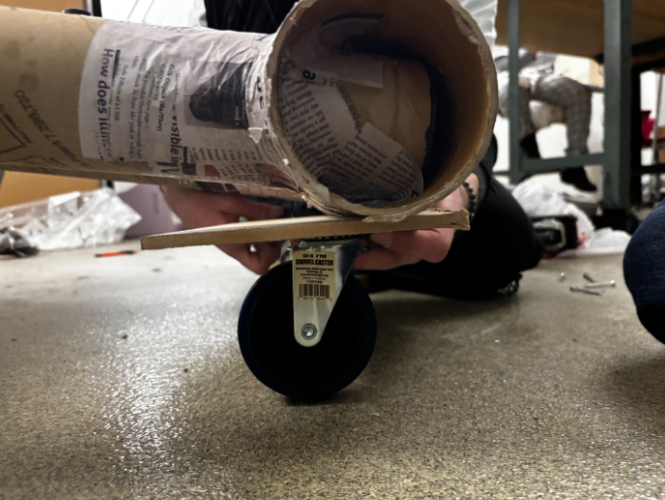
At the start of the challenge, as a team, we were tasked to generate as many ideas as possible. Afterwards, we narrowed it down to only two designs: the wheelchair and the tricycle. The final design functioned as a wheelchair, with the focus on free-rotating wheels that would allow for turning.




Conclusion
In this project, we have successfully demonstrated the design, manufacturing, and analysis process involved in the creation of a fully functional paper-based vehicle Despite the final result, we consider this project a success by applying engineering concepts seen throughout our undergraduate degree, such as strength of materials, mechanical design, and design. This project overall highlighted the value of teamwork and adaptability in the engineering field.
